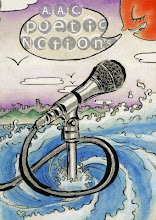
As you know, A.A.C. is holding it's second edition of Poetic Notions this Saturday. What you may not know is the definition of a poetry slam. Well, let me help you out...
What is a poetry slam anyway?
Basically, a poetry slam is a competition where individuals perform poetry. The poets usually read or recite their own work, but not always. The performances are then scored by judges.
Poetry slams were founded in the mid-80s as a way to get people interested in poetry readings. It has since developed into an international art form that emphasizes the audience’s involvement and poetic excellence.
Where did it come from?
According to slampapi.com, in 1985, construction worker and poet Marc Smith (slampapi) established a poetry reading series at the Get Me High Lounge, a Chicago jazz club. He started it as a way to “breathe life into the open mike poetry format.”
The series’ placed importance on performance and laid the groundwork for a style which would ultimately be spread all over. The owner of Green Mill, another Chicago jazz club agreed to let Smith host a weekly poetry cabaret on the club’s slow Sunday nights. The Uptown Poetry Slam was born July 25, 1986.
“Smith drew on baseball and bridge terminology for the name and instituted the show’s basic structure of an open mike, guest performers and a competition. The Green Mill evolved into the Mecca for performance poets and the Uptown Poetry Slam still continues.”
From The Complete Idiot’s Guide to Slam Poetry: “Slam poetry is the brainchild of Marc Smith (So What!), and the blue collar intellectual eccentrics who crammed into the Get Me High Lounge on Monday nights from November 1984 to September 1986 for a wide-open poetry experience. Finger-poppin’ hipster Butchie (James Dukaris) owned the place and allowed anything to happen, and it usually did. The experimenters in this new style of poetry presentation gyrated, rotated, spewed, and stepped their words along the bar top, dancing between the bottles, bellowing out the backdoor, standing on the street or on their stools, turning the west side of Chicago into a rainforest of dripping whispers or a blast furnace of fiery elongated syllables, phrases, snatches of scripts, and verse that electrified the night.”
The general rules for poetry slams are:
Each poem has to be an original work by the poet.
Each poet gets three minutes [and a ten-second grace period] to read one poem. If the poet goes over, points will be taken away from the total score.
Poets can’t use props, costumes or musical instruments.
Of the scores the poet received from the five judges, the high and low scores are dropped and the middle three added together; this gives the poet a total score of 1-30.
**Note that rules vary from slam to slam.**
But as slammaster Allan Wolf stated, “The points are not the point; the point is poetry.”

 **Don't forget to check out A.A.C. and the other poets at Poetic Notions, Saturday, April 18 at 7 PM. Tickests are $3 in advance and $5 at the door. It will be held at the MSU Lounge at Georgia College & State University. For more info, contact A.A.C. at aacshutdown@gmail.com.